Customer Messaging

Created a unified messaging strategy across digital.

Customer Messaging

Created a unified messaging strategy across digital.

Balanced business needs against customer experience to develop a comprehensive messaging strategy (email, SMS and push) for Albertsons

Before I joined Albertsons, the app had a messaging problem: a newly launched in-app pop-up banner drove strong engagement but also spiked complaints, dropped app store ratings, and increased uninstalls. In optimizing for conversion, the team overlooked the rest of the experience.

As head of content, I was handed a narrow brief: develop guidelines for in-app messaging to reduce the frequency and size of interruptions. However, when I mapped the customer experience, it became clear that the in-app banner wasn’t an isolated issue but a symptom of a broader problem.

Customers weren’t just being interrupted in the app. They received emails, SMS, push notifications, and in-app messages from multiple teams on overlapping schedules, with no shared logic for prioritization or frequency. On any given day, a customer might encounter the same promotion across multiple touchpoints.

I expanded my remit to develop a comprehensive customer messaging framework for prioritization, placement, sizing, and frequency that the entire organization could work from.

Before I joined Albertsons, the app had a messaging problem: a newly launched in-app pop-up banner drove strong engagement but also spiked complaints, dropped app store ratings, and increased uninstalls. In optimizing for conversion, the team overlooked the rest of the experience.

As head of content, I was handed a narrow brief: develop guidelines for in-app messaging to reduce the frequency and size of interruptions. However, when I mapped the customer experience, it became clear that the in-app banner wasn’t an isolated issue but a symptom of a broader problem.

Customers weren’t just being interrupted in the app. They received emails, SMS, push notifications, and in-app messages from multiple teams on overlapping schedules, with no shared logic for prioritization or frequency. On any given day, a customer might encounter the same promotion across multiple touchpoints.

I expanded my remit to develop a comprehensive customer messaging framework for prioritization, placement, sizing, and frequency that the entire organization could work from.

Analysis

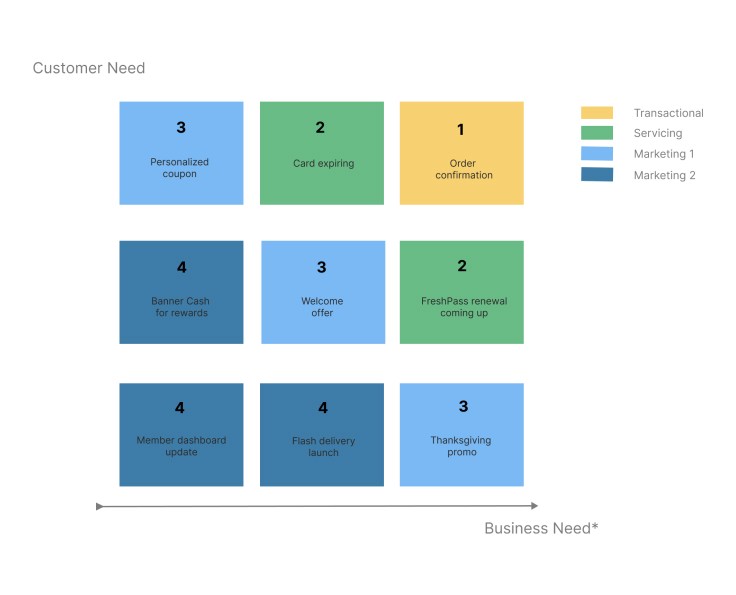
I began with a three-month audit of all outgoing customer messages across every channel. From that, I established four criteria for categorizing any message before it was sent: type (transactional, servicing, or marketing), format (the components needed for a customer to immediately understand what kind of message it was), placement (contextual, appearing close to the point of need rather than interrupting unrelated tasks), and order (the logic governing frequency and sequencing when multiple messages were queued for the same customer).

Solution

The resulting guidelines covered design standards, component specifications, and sequencing rules. Sequencing was the most consequential part. It introduced the concept of frequency caps tied to actual customer behavior rather than arbitrary limits. For example, in-app interruptions would be capped based on average visit frequency, ensuring no customer would encounter an interruptive message more than 25% of the time they opened the app.

Because guidelines need at least some enforcement, my plan included "light" governance: a review committee for any messages appearing on the homepage, a recurring audit process for other placements, and training sessions for every team responsible for customer communications.

Outcome

Within six months of launching the new strategy, average interruptions per session were cut in half. The app store rating increased by 1.7 stars. Opt-outs dropped by 30%. And, by shifting governance from control to enablement, I was able to improve consistency without creating a bottleneck

Contact

Ready to explore?

Let's have a quick conversation about direction.

Contact

Ready to explore?

Let's have a quick conversation about direction.

Contact

Ready to explore?

Let's have a quick conversation about direction.